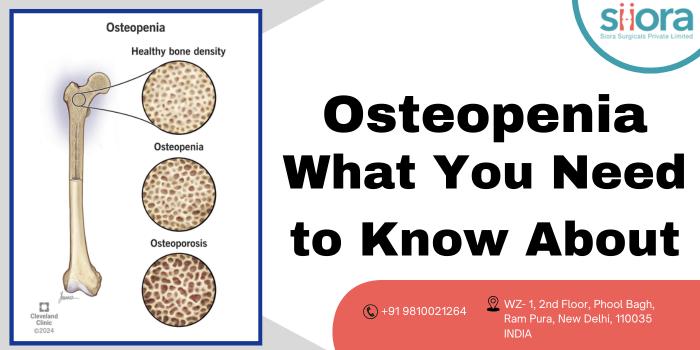
Aging is accompanied by many health conditions, and one of the commonest being the weakening of bones. This post of ours will talk about one such condition that is characterized by weakened bones. Osteopenia is the condition about which you’ll learn after going through the post.
In layman’s terms, osteopenia is the mid-point of having healthy bones and getting osteoporosis. In other words, people suffering from osteopenia will have weak bones but not weak enough to get broken easily. But this condition could become serious if ignored and not diagnosed timely. Such situations may require surgery for the treatment, and it may also require orthopedic implants and orthopedic instruments to stabilize the fractured bone fragments.
On average, at 35 years of age bone density is at its peak in the individuals, and as the age increases after that, the bone starts deteriorating at a slow rate that increases with time. People suffering from osteopenia have low bone density when compared to healthy individuals. But the density is not so low that it would result in an easy bone break.
Osteopenia increases the chances of developing osteoporosis, which is a severe form of osteopenia. People suffering from osteoporosis can get fractures anytime without any reason or even with a slight fall.
What Are the Causes of Osteopenia?
Constant breaking down of old bones and formation of new ones throughout a person’s life is common. At a young age, the rate at which new bone forms is faster than the breakdown. Therefore, the bone density reaches its peak at around 35 years of age.
Now, after a certain age, the process just becomes the opposite, and the breakdown of the bone becomes faster than the formation of the new bone. That’s where the problem starts to arise. When such a stage comes, bone density begins to decrease.
Low bone mineral density means weak bones and they could break easily. When this process is in its early stages, the condition is known as osteopenia. In later stages, when the rate of breakdown of bones increases, osteoporosis could develop in some people.
Several studies have found that women are more prone to developing osteopenia than men, and there are several factors associated with that. Here, one of the key factors is that women have lower bone mass when compared to men. Another reason is menopause.
What Are the Symptoms of Osteopenia?
You will be surprised to know that people suffering from osteopenia don’t show symptoms as in the initial stages the loss of bone density is low. This does not result in pain, difficulty in movement, or any other symptoms. Problems start to occur when the condition develops into osteoporosis.
How is Osteopenia Diagnosed?
Now, the question here is that when the symptoms are not there then how a person would know that he/she is suffering from any condition. So, the condition can be diagnosed during regular health checkups, especially in older people. To check whether the person has osteopenia or not, a bone mineral density test is performed, and it should be done in:
- People 65 years of age or older, especially women
- Women post menopause
How is Osteopenia Treated?
Some lifestyle changes could do well when it comes to treating osteopenia. The doctor would suggest weight-bearing exercises to strengthen bones and maintain bone mineral density. Increasing physical activity is known to be highly effective for people suffering from osteopenia. Besides this, the doctor will also suggest having a calcium and vitamin D-rich diet.
For the content source, contact Siora Surgicals Pvt. Ltd., a CE-certified manufacturer and exporter of trauma implants in India. The company is also working hard to be known as one of the leading orthopaedic companies in Argentina.
 Orthopedic Implants Suppliers